How many pallets fit in a truck?

Jens Brauer
Software Engineer
“How many pallets fit in a truck?” doesn’t have one universal answer. A standard 53’ dry van trailer holds a different count than a 26’ box truck, a Euro pallet packs differently than a US GMA pallet, and simply turning every pallet 90° can change the total by several units. This guide walks through the math behind the two most common setups, and how Cargo-Planner turns the same calculation into an exact number for your own equipment and cargo.
The pallet math, in principle
Fitting pallets on a trailer floor is a 2D packing problem: how many pallet footprints fit across the available length and width. For a single pallet type loaded in one consistent orientation, the floor-loaded count is:
floor(trailer length / pallet depth) × floor(trailer width / pallet width)
Turning every pallet 90° swaps which pallet dimension runs along the trailer’s length, which usually changes the total - sometimes for the better, sometimes not. That’s why the two orientations below give different answers for the same trailer.
Standard 48”×40” pallets, by truck and trailer size
Worked example first, then a reference table for the other common sizes.
A standard 53’ dry van trailer has roughly 630” (52.5ft) of usable interior length and about 100” (8.3ft) of interior width. Exact figures vary by manufacturer, so treat these as a starting point and check your carrier’s spec sheet before relying on them.
Loaded lengthwise, with the pallet’s 48” side running along the trailer:
floor(630 / 48) × floor(100 / 40) = 13 × 2 = 26 pallets
Turned broadside, with the 40” side running along the trailer instead:
floor(630 / 40) × floor(100 / 48) = 15 × 2 = 30 pallets
Turning the pallets gains 4 extra floor spots in this example - a trade-off a fixed “X pallets per trailer” number can’t show you, because it depends on your specific pallet footprint, not just the truck.
The same formula applies to other common sizes. These are commonly cited industry-standard interior dimensions, not measurements of a specific manufacturer’s model - always check your own equipment’s spec sheet before committing to a number:
| Truck / trailer | Interior (L × W) | Lengthwise | Turned 90° |
|---|---|---|---|
| 53’ dry van trailer | 630” × 100” (52.5 × 8.3ft) | 26 pallets | 30 pallets |
| 48’ dry van trailer | 576” × 100” (48 × 8.3ft) | 24 pallets | 28 pallets |
| 26’ box truck | 300” × 96” (25 × 8ft) | 12 pallets | 14 pallets |
Box trucks vary more than trailers do - a 26’ box truck’s interior comes from whichever chassis and body manufacturer built it, so treat that row as a starting estimate more than the trailer rows.
Euro pallets in a box trailer
The same method works on the metric side. We’ve already walked through this exact calculation in our loading meters guide: a Euro pallet (1.2 × 0.8m) in a Box Trailer (EU) works out to about 34 pallets floor-loaded.
Where the hand calculation breaks down
None of the maths above accounts for:
- Stacking. If the cargo is stackable and the trailer’s height allows it, the real count can be significantly higher than the floor count.
- Mixed pallet sizes. Real shipments rarely use one uniform footprint - a second or third pallet size changes the optimal layout entirely.
- Weight limits. A trailer can run out of legal axle or gross weight before it runs out of floor space, especially with heavier cargo.
- Real trailer geometry. Wheel wells, door swing, and the front bulkhead all eat into the numbers above.
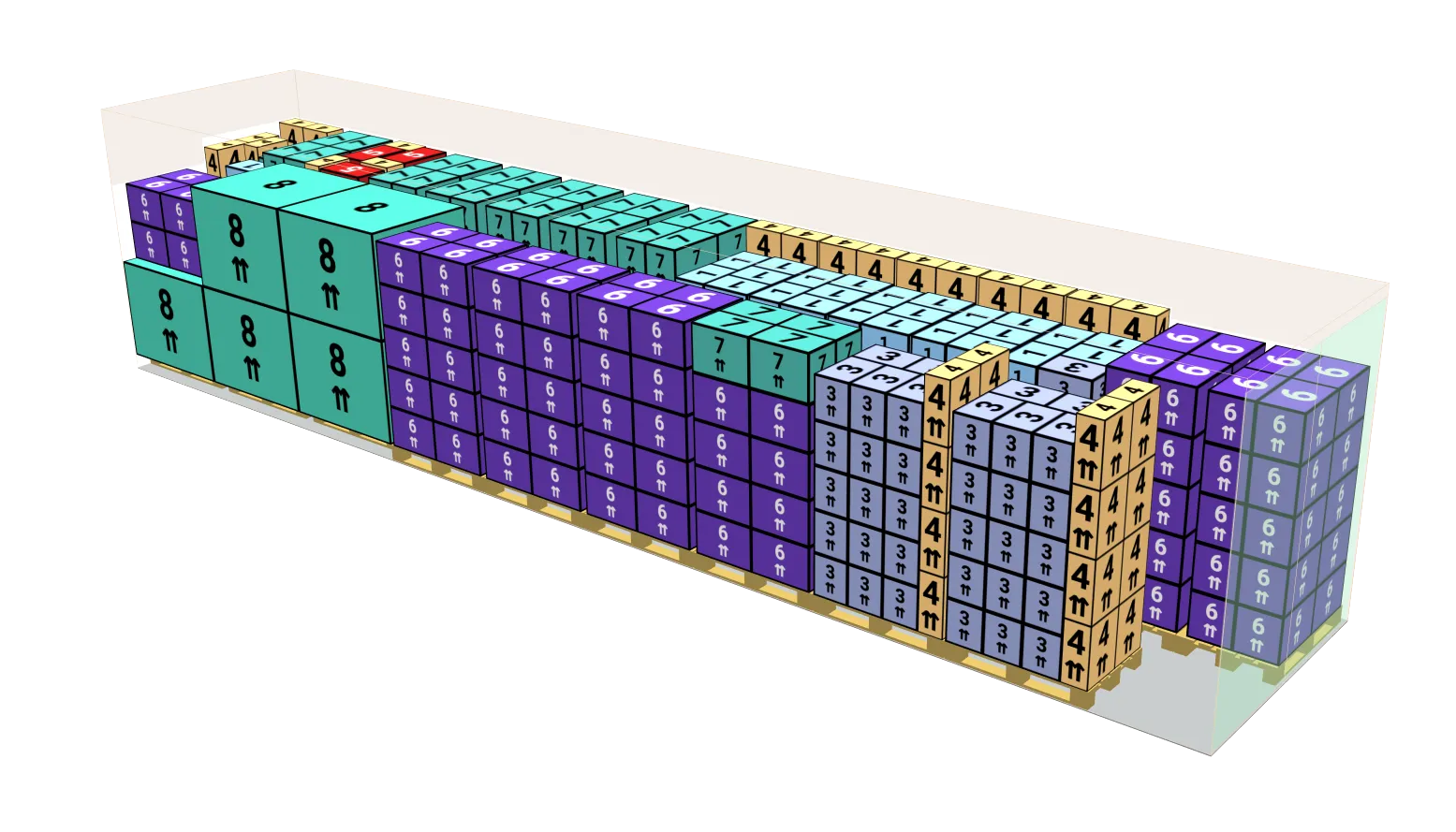
Cargo-Planner accounts for all of this automatically. Give it your trailer or container, your pallet dimensions (or pick one from the equipment library), and it calculates the exact number that fits - stacked or not, mixed sizes or not, weight limits included - for your specific equipment instead of a rounded industry estimate.